Flexible vs Stiff Boning & Fillet Knives Choosing the Right Tool
Description
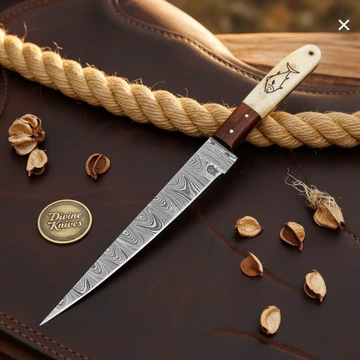
Selecting the right blade flexibility is one of the most important decisions when investing in a Boning & Fillet Knife. While these knives share slim, pointed profiles, their flexibility dictates how they interact with bone, cartilage, skin, and muscle tissue. At Divineknives, we design specialized tools to match specific butchery techniques so you can achieve clean cuts every time.
Using a blade with the wrong flex profile can lead to torn fish flesh, lost meat yield, or premature blade damage. Exploring how flexible, semi-flexible, and stiff blades perform across different proteins helps you choose the perfect knife for your kitchen prep.
Flexible Blades: The Perfect Choice for Delicate Fish Filleting
Flexible blades are engineered to bend under light pressure, allowing the edge to trace the natural curve of ribs and skin. When skinning a salmon fillet or working around small pin bones, a flexible Boning & Fillet Knife glides smooth along the skin surface without cutting through it.
This bending ability allows you to harvest maximum yield from delicate fish species like trout, flounder, and snapper. Attempting this task with a rigid blade often leads to gouging the flesh or leaving valuable meat stuck to the skin. Divineknives crafts flexible blades with uniform spring-temper memory, ensuring the steel flexes smoothly and snaps back straight after every pass.
Stiff Blades Power and Leverage for Heavy Meat Butchery
When your butchery tasks shift from sea to land, rigid blades provide the structural leverage needed to separate dense muscle groups from heavy bone. A stiff Boning & Fillet Knife easily slices through thick connective tissue, cartilage, and fat caps on beef chuck, pork shoulders, and venison.
The firm spine of a rigid blade prevents the knife from deflecting off course when cutting around joint sockets or separating ribs. This stiffness allows you to apply controlled pressure directly where needed without the blade flexing unexpectedly. The bladesmiths at Divineknives forge thick-spined stiff knives that deliver unwavering stability during heavy-duty butchery.
Semi-Flexible Blades The Versatile All-Rounder Option
For home cooks seeking one knife to handle a wide variety of kitchen prep, a semi-flexible blade offers an excellent compromise between bending capability and structural strength:
A semi-flexible Boning & Fillet Knife has enough give to contour around chicken rib cages while retaining sufficient rigidity to trim pork loins and segment large fish like tuna. At Divineknives, our semi-flexible models provide versatile performance across everyday home butchery tasks.
Tip Designs: Curved Trailing Points vs Straight Piercing Tips
The shape of the blade tip plays a key role in initial punctures and continuous slicing strokes. Curved trailing-point tips sweep upward, providing a long cutting surface that excels at sweeping passes when skinning fish or trimming large fat caps.
Conversely, straight or narrow piercing tips offer surgical accuracy for puncturing skin, cutting into joint capsules, and removing silver skin from tenderloins. Choosing the right tip profile ensures your knife works naturally with your preferred cutting technique. Divineknives offers both curved and straight tip profiles designed for optimal control.
Conclusion
Understanding the distinct roles of flexible, semi-flexible, and stiff blades is key to selecting the ideal Boning & Fillet Knife for your kitchen. Flexible blades excel at skinning delicate fish, while stiff blades provide the power needed for heavy meat butchery. At Divineknives, our hand-forged butchery collection offers precision control across all flex profiles. Equip your kitchen with the right tool today and enjoy effortless precision on every cut.