The Future of Electronic Health Records in 2026 and Beyond
Description
The future of electronic health records (EHRs) is being shaped by rapid advancements in artificial intelligence, interoperability, cloud computing, cybersecurity, and patient engagement technologies. As healthcare organizations continue their digital transformation journeys, EHR systems are evolving from documentation tools into intelligent platforms that support clinical decision-making, improve patient outcomes, and streamline healthcare operations.
In 2026 and beyond, healthcare leaders will face growing demands for connected care, real-time data sharing, enhanced patient experiences, and operational efficiency. Next-generation EHR systems are expected to play a central role in meeting these demands while enabling more personalized, data-driven healthcare delivery.
This article explores the major trends, opportunities, and challenges that will define the electronic health records future and how healthcare organizations can prepare for the next era of healthcare technology.
Key Takeaways
- AI-powered EHRs will reduce documentation burdens and support clinical decision-making.
- Healthcare interoperability will become essential for seamless data exchange.
- Cloud-based EHR platforms will drive scalability, flexibility, and innovation.
- Patient engagement technology will create more personalized healthcare experiences.
- Predictive analytics in healthcare will improve population health management.
- Healthcare cybersecurity will remain a critical priority.
- Automation will transform administrative and clinical workflows.
- Emerging technologies such as generative AI and remote monitoring will expand EHR capabilities.
The Current State of Electronic Health Records
Electronic Health Records have become the foundation of modern healthcare operations. Most hospitals, health systems, and physician practices now rely on EHR platforms to manage patient information, coordinate care, and meet regulatory requirements.
Over the past decade, healthcare organizations have made significant investments in digital health infrastructure. These investments have improved access to patient information and enabled better clinical coordination. However, many organizations continue to face challenges related to usability, data sharing, and clinician workload.
Current Challenges Facing EHR Systems
Healthcare organizations commonly struggle with:
- Documentation inefficiencies
- Physician burnout
- Limited interoperability
- Data silos
- Cybersecurity risks
- Complex compliance requirements
As these challenges persist, healthcare leaders are looking toward innovation to unlock greater value from their EHR investments.
AI-Powered EHRs Will Transform Clinical Workflows
One of the most significant EHR trends in 2026 is the integration of artificial intelligence into everyday healthcare workflows.
AI is no longer viewed as a futuristic concept. It is increasingly becoming an operational necessity that helps clinicians manage growing workloads while improving patient care.
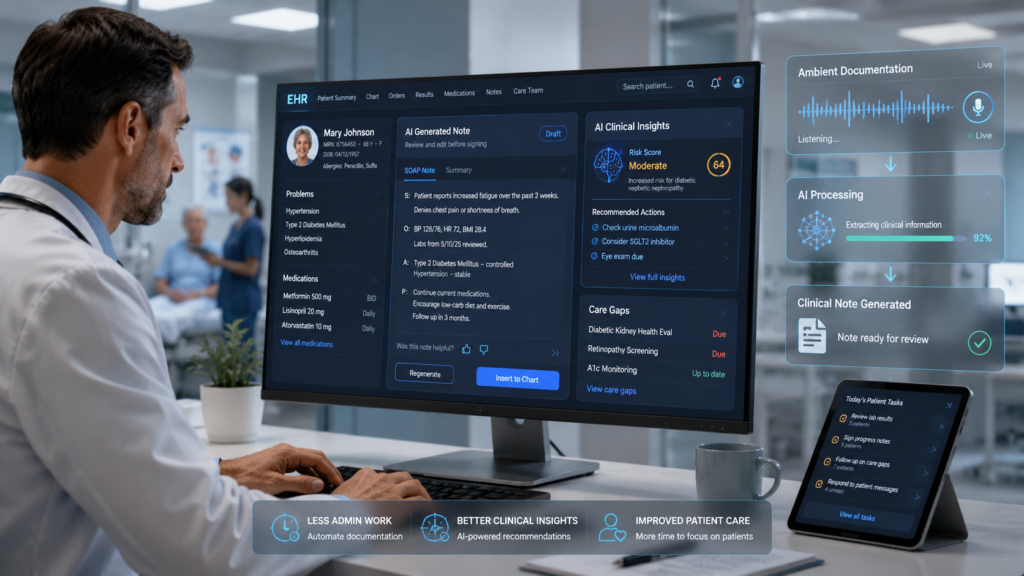
Ambient Clinical Documentation
Documentation remains one of the largest contributors to clinician burnout. AI-powered ambient documentation tools are helping address this issue by automatically capturing conversations between providers and patients.
Benefits include:
- Reduced administrative burden
- Faster note completion
- Improved documentation quality
- More patient-focused interactions
Rather than spending hours completing charts, providers can dedicate more time to direct patient care.
Clinical Decision Support
AI-powered clinical decision support systems can analyze patient data in real time and provide recommendations that support evidence-based care.
Potential applications include:
- Early disease detection
- Risk stratification
- Medication recommendations
- Preventive care alerts
These capabilities help clinicians make informed decisions while reducing the likelihood of errors.
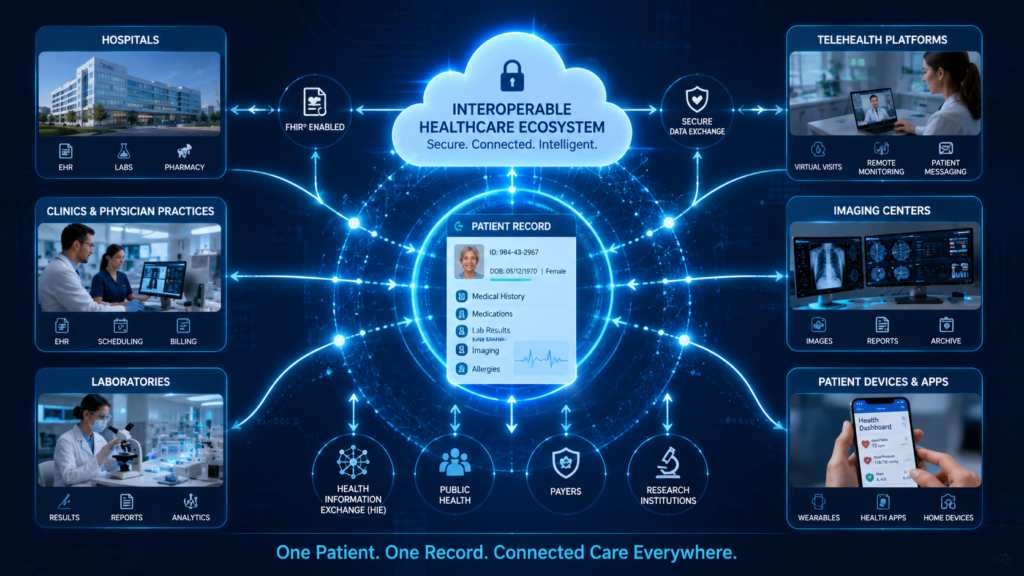
The Future of Electronic Health Records Depends on Interoperability
Healthcare interoperability is becoming one of the most important priorities for healthcare organizations worldwide.
Interoperability refers to the ability of healthcare systems, applications, and devices to exchange and use data seamlessly across organizations.
Why Interoperability Matters
Patients often receive care from multiple providers across different healthcare networks. Without effective interoperability, important patient information can become fragmented.
Benefits of improved interoperability include:
- Better care coordination
- Reduced duplicate testing
- Faster diagnosis and treatment
- Improved patient safety
- Enhanced operational efficiency
The Role of FHIR Standards
Fast Healthcare Interoperability Resources (FHIR) have emerged as a leading framework for healthcare data exchange.
FHIR enables:
- Secure API-based data sharing
- Real-time information exchange
- Easier integration with healthcare applications
- Improved patient access to health records
As adoption grows, interoperability will become a defining feature of next-generation EHR systems.
Cloud-Based EHR Platforms Will Continue to Expand
Cloud computing is transforming the way healthcare organizations deploy and manage EHR solutions.
Traditional on-premise systems often require substantial infrastructure investments and ongoing maintenance. Cloud-based EHR platforms offer a more flexible and scalable alternative.
Benefits of Cloud-Based EHR Systems
Healthcare organizations can benefit from:
- Lower infrastructure costs
- Faster software updates
- Improved disaster recovery
- Greater scalability
- Enhanced accessibility
Cloud technology also enables healthcare organizations to rapidly adopt new innovations without extensive hardware investments.
Challenges to Consider
While cloud adoption continues to increase, organizations must address:
- Data security concerns
- Compliance requirements
- Vendor dependency risks
- Migration complexity
Organizations that successfully navigate these challenges can gain significant operational advantages.
Patient-Centered EHR Experiences Will Grow
Modern healthcare consumers expect digital experiences that match the convenience they receive in other industries.
As a result, patient engagement technology is becoming a key component of the future of electronic health records.
Empowering Patients Through Digital Access
Patients increasingly expect:
- Online appointment scheduling
- Mobile health applications
- Digital communication tools
- Access to personal health records
- Virtual care options
EHR systems are evolving to support these expectations through integrated patient engagement capabilities.
Personalized Healthcare Experiences
Future EHR platforms will use data-driven insights to deliver:
- Personalized care recommendations
- Preventive health reminders
- Tailored communication strategies
- Individualized treatment plans
These innovations can improve patient satisfaction while supporting better health outcomes.
Predictive Analytics and Population Health Will Drive Better Outcomes
Healthcare organizations are generating enormous amounts of data every day. The challenge lies in converting that data into actionable insights.
Predictive analytics in healthcare is helping organizations identify trends, anticipate risks, and improve care delivery.
Population Health Management
Advanced analytics tools can help healthcare organizations:
- Identify high-risk patients
- Monitor chronic disease populations
- Address care gaps
- Improve preventive care initiatives
This proactive approach enables healthcare systems to focus on prevention rather than simply reacting to illness.
Predictive Risk Assessment
AI and machine learning models can identify patients who may be at risk for:
- Hospital readmissions
- Disease progression
- Medication non-adherence
- Adverse health events
Early intervention can significantly improve patient outcomes while reducing healthcare costs.
Healthcare Cybersecurity Will Remain a Top Priority
As healthcare becomes increasingly digital, cybersecurity threats continue to grow.
Healthcare data remains one of the most valuable targets for cybercriminals due to its sensitivity and long-term value.
Emerging Security Challenges
Healthcare organizations face risks such as:
- Ransomware attacks
- Data breaches
- Insider threats
- Third-party vulnerabilities
- Identity theft
Future Cybersecurity Strategies
Leading organizations are adopting:
- Zero Trust security frameworks
- Multi-factor authentication
- Continuous monitoring systems
- AI-powered threat detection
- Enhanced data governance programs
Strong cybersecurity practices will be essential for maintaining trust and regulatory compliance.
The Role of Automation in Healthcare Operations
Automation is becoming a critical component of healthcare digital transformation.
By reducing repetitive administrative tasks, automation enables healthcare professionals to focus on higher-value activities.
Administrative Automation
Areas where automation is making an impact include:
- Patient registration
- Appointment scheduling
- Claims processing
- Prior authorization workflows
- Revenue cycle management
Clinical Workflow Automation
Healthcare organizations are also automating:
- Care coordination activities
- Follow-up reminders
- Medication management
- Clinical task assignments
These improvements can increase efficiency while reducing operational costs.
Emerging Technologies Shaping the Future of EHRs
Several emerging technologies are expected to redefine the capabilities of EHR systems over the next decade.
Generative AI
Generative AI is poised to transform healthcare documentation, information retrieval, and clinical support.
Potential use cases include:
- Clinical note generation
- Patient communication assistance
- Medical summarization
- Knowledge management
Remote Patient Monitoring
Connected devices are allowing healthcare providers to monitor patients outside traditional clinical settings.
Benefits include:
- Continuous health tracking
- Earlier intervention
- Reduced hospital admissions
- Improved chronic disease management
Precision Medicine
Future EHR systems will increasingly integrate genomic and personalized health data.
This integration will support:
- Personalized treatment plans
- Improved medication selection
- Better disease prediction models
Digital Twins and Advanced Modelling
Healthcare innovators are exploring digital twin technologies that create virtual representations of patients to simulate treatment outcomes and support decision-making.
What Healthcare Leaders Should Do Now
The healthcare landscape is evolving rapidly, and organizations that prepare today will be better positioned for future success.
Invest in Interoperability
Healthcare leaders should prioritize systems that support seamless data exchange and compliance with evolving interoperability standards.
Develop AI Governance Strategies
As AI adoption increases, organizations need clear governance frameworks that ensure ethical, transparent, and responsible use of AI technologies.
Strengthen Cybersecurity Programs
Cybersecurity should be treated as a strategic priority rather than solely an IT responsibility.
Focus on User Experience
Improving clinician and patient experiences can increase technology adoption and maximize the value of EHR investments.
Prepare for Continuous Innovation
Healthcare technology will continue to evolve. Organizations should establish flexible digital strategies that allow them to adapt quickly to emerging opportunities.
Conclusion
The future of electronic health records extends far beyond digital documentation. By 2026 and beyond, EHR systems will become intelligent, interconnected platforms that support clinical decision-making, enhance patient engagement, improve population health management, and drive operational efficiency.
Artificial intelligence, healthcare interoperability, cloud-based EHR infrastructure, predictive analytics, automation, and advanced cybersecurity practices will collectively shape the next generation of healthcare technology.
Healthcare organizations that embrace these innovations while maintaining a focus on patient outcomes, data security, and user experience will be best positioned to thrive in the future of digital healthcare.
Frequently Asked Questions
What is the future of electronic health records?
The future of electronic health records involves greater use of AI, interoperability, cloud computing, predictive analytics, automation, and patient-centered digital experiences.
How will AI impact EHR systems?
AI will automate documentation, support clinical decision-making, identify patient risks, and improve operational efficiency across healthcare organizations.
Why is healthcare interoperability important?
Interoperability enables healthcare providers to securely exchange patient data, improving care coordination, patient safety, and clinical outcomes.
Are cloud-based EHR systems secure?
Modern cloud-based EHR platforms can be highly secure when supported by strong cybersecurity measures, compliance frameworks, encryption, and access controls.
What are the most important EHR trends for 2026?
Key EHR trends include AI-powered workflows, healthcare interoperability, cloud adoption, predictive analytics, patient engagement technology, automation, and cybersecurity enhancements.
How can healthcare organizations prepare for next-generation EHR systems?
Organizations should invest in interoperability, strengthen cybersecurity, adopt AI governance frameworks, optimize workflows, and prioritize digital transformation initiatives.